
A Coriolis flow meter is a highly accurate instrument for measuring the mass flow rate of liquids and gases. It uses the Coriolis effect to measure mass flow directly. Unlike many traditional flow meters, it does not need to calculate mass flow from fluid velocity and density.
Coriolis flow meters can also measure fluid density and temperature. This makes them useful in industries that require accurate flow measurement and process control.
But how does a Coriolis flow meter work? What makes it different from other flow meters? This article explains its working principle, main components, advantages, and common applications.
1. What Is a Coriolis Flow Meter?
A Coriolis flow meter, also known as a Coriolis mass flow meter, is a device that measures the mass of fluid passing through a pipe per unit of time.
Its working principle is based on the Coriolis effect. This physical effect occurs when a moving object travels within a rotating reference frame.
A Coriolis flow meter uses vibrating measuring tubes to create this effect. When fluid flows through these tubes, it produces a Coriolis force. This force causes a small deformation in the tubes. Sensors detect this movement and calculate the mass flow rate.
Most Coriolis flow meters can provide several measurement values, including:
- Mass flow rate: The mass of fluid passing through the meter per unit of time.
- Density: The mass of fluid per unit of volume.
- Temperature: The temperature of the fluid inside the measuring tube.
- Volume flow rate: A value calculated from mass flow rate and density.
These measurements help operators monitor fluid conditions and control industrial processes.
2. How Does a Coriolis Flow Meter Work?
A Coriolis flow meter works by detecting changes in the vibration of its measuring tubes. Its operation involves three main steps.
Step 1: The Measuring Tubes Start to Vibrate
When the meter receives power, an electromagnetic drive system makes the measuring tubes vibrate at their natural frequency.
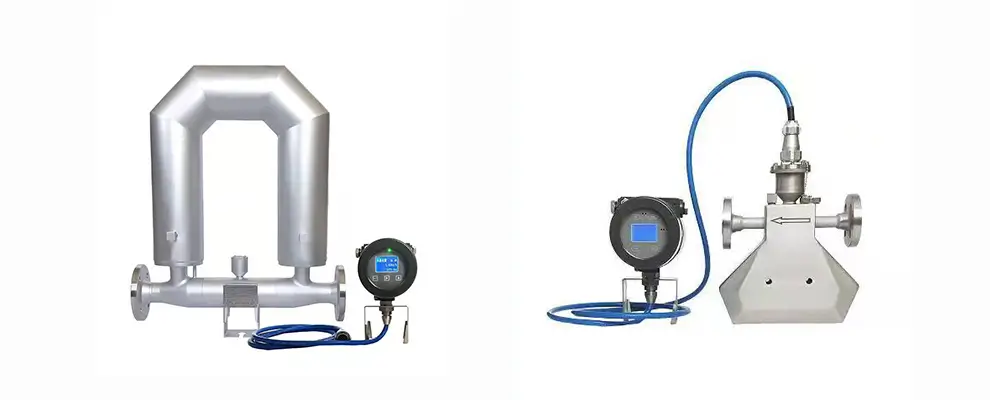
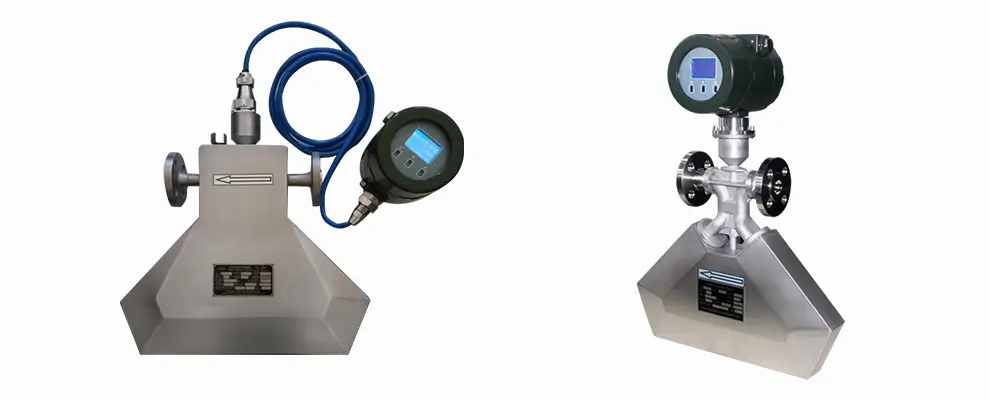
Depending on the meter design, the tubes may have a U-shaped, curved, or straight structure.
Before fluid starts flowing, both sensors detect the same vibration pattern. There is no flow-induced phase difference between their signals.
Step 2: Fluid Flows Through the Measuring Tubes
When liquid or gas enters the meter, it moves through the vibrating tubes.
The moving fluid interacts with the tube’s vibration and produces Coriolis forces. These forces cause the tubes to twist or bend slightly.
The inlet and outlet sections respond differently to these forces. As a result, their vibration signals develop a small phase difference.
In general, a higher mass flow rate produces a greater phase difference.
Step 3: Sensors Calculate the Mass Flow Rate
Two sensors usually monitor the vibration of the measuring tubes. They detect movement at different positions and send signals to the transmitter.
The transmitter analyzes the phase difference between the signals. It then calculates the mass flow rate.
In simple terms:
- No flow: There is no flow-induced phase difference between the sensor signals.
- Fluid flowing: A phase difference appears between the signals.
- Higher mass flow: The phase difference generally becomes larger.
This allows the meter to measure mass flow directly without relying on a separate density measurement.
3. How Does a Coriolis Flow Meter Measure Density?
Besides mass flow, a Coriolis flow meter can also measure fluid density.
It uses the natural vibration frequency of the measuring tubes.
The principle is similar to a spring with an attached mass. When the mass inside a vibrating system changes, its natural frequency also changes.
When the measuring tubes contain a denser fluid, the total vibrating mass increases. This usually lowers the natural frequency.
The meter detects this frequency change and calculates the fluid density based on its calibration data.
For example, water and oil have different densities. When they flow through the same Coriolis meter, the tube vibration frequencies will differ.
The transmitter uses the measured frequency and calibration parameters to determine the fluid density.
An integrated temperature sensor also measures the tube temperature. The meter uses this information to compensate for temperature-related changes in the tube’s mechanical properties.
4. Main Components of a Coriolis Flow Meter
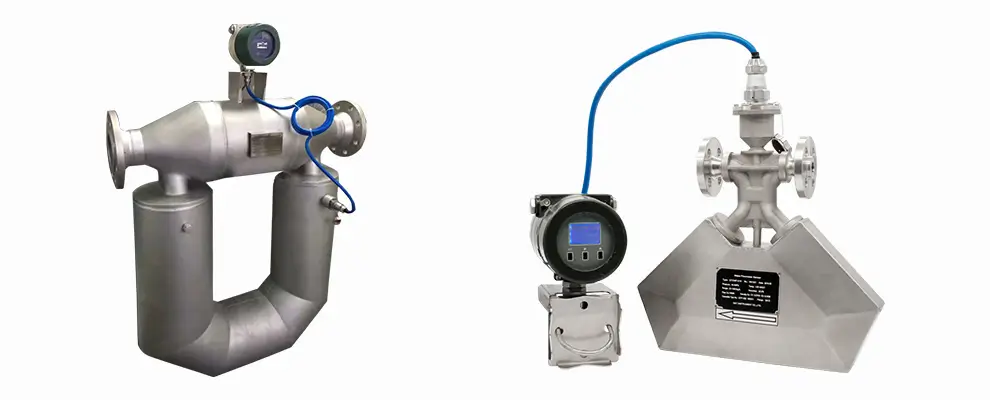
A typical Coriolis flow meter consists of several important components. Each component plays a specific role in the measurement process.
4.1 Measuring Tubes
The measuring tubes provide the flow path for the fluid. They also vibrate during operation.
Their shape and material depend on the meter design and application requirements.
Common designs include U-shaped, curved, and straight measuring tubes.
4.2 Drive System
The drive system generates and maintains tube vibration.
Most designs use an electromagnetic drive system. It keeps the tubes oscillating at their natural frequency.
4.3 Sensors
The sensors monitor the movement of the measuring tubes.
They detect changes in vibration frequency and phase. These signals help the transmitter calculate mass flow and density.
4.4 Temperature Sensor
The temperature sensor monitors the temperature of the measuring tubes.
The meter uses this measurement to compensate for temperature effects. It can also provide process temperature data.
4.5 Transmitter
The transmitter receives and processes signals from the sensors.
It calculates measurement values and displays the results. Depending on the model, it can also send signals to a PLC, DCS, or other control system.
5. What Are the Advantages of a Coriolis Flow Meter?
Coriolis flow meters offer several advantages for industrial flow measurement.
5.1 Direct Mass Flow Measurement
A major advantage is their ability to measure mass flow directly.
Many traditional flow meters measure velocity or volume flow first. They may need additional density data to calculate mass flow.
A Coriolis flow meter measures mass flow without this extra calculation.
5.2 High Measurement Accuracy
Coriolis flow meters provide high measurement accuracy and repeatability.
They are suitable for applications that require precise fluid measurement, such as chemical dosing, batching, and product transfer.
Actual accuracy depends on the meter model and operating conditions.
5.3 Multiple Measurement Values
One instrument can provide mass flow, density, and temperature measurements.
Some models can also calculate volume flow and other process variables.
This reduces the need for multiple instruments in certain applications.
5.4 Wide Range of Fluid Applications
Coriolis flow meters can measure many types of liquids and gases.
They are suitable for applications involving water, oil, chemicals, fuels, and some high-viscosity fluids.
However, users should select a suitable model based on fluid properties, pressure, temperature, and flow conditions.
5.5 Less Sensitivity to Flow Profile
Coriolis flow meters do not rely on measuring fluid velocity at a specific point in the pipe.
Therefore, their measurements are generally less sensitive to changes in flow profile than those of some velocity-based flow meters.
This can make installation easier in certain applications. However, users should still follow the manufacturer’s installation requirements.
6. Common Applications of Coriolis Flow Meters
Coriolis flow meters are widely used in industries that need accurate mass flow measurement.
Common applications include:
Chemical Industry
Chemical plants use Coriolis flow meters to measure acids, solvents, and other process fluids. Accurate measurement helps control chemical dosing and production processes.
Oil and Gas Industry
These meters measure crude oil, natural gas, fuels, and other hydrocarbons. They are also used in loading, unloading, and fuel transfer systems.
Food and Beverage Industry
Food manufacturers use Coriolis flow meters to measure milk, syrup, oils, and other ingredients. Accurate measurement helps maintain product quality and control filling processes.
Pharmaceutical Industry
Pharmaceutical manufacturers need precise fluid measurement during production. Coriolis flow meters help control liquid dosing and ingredient mixing.
Water and Wastewater Industry
Coriolis flow meters can measure water, sludge, and certain process chemicals. They are useful when an application requires direct mass flow or density measurement.
However, for general water supply and distribution, electromagnetic and ultrasonic flow meters may offer a more economical solution.
7. What Should You Consider When Selecting a Coriolis Flow Meter?
Choosing the right Coriolis flow meter is important for accurate and stable measurement. Before purchasing, consider the following factors.
7.1 Fluid Type
Identify whether the fluid is a liquid or gas.
You should also check its density, viscosity, chemical properties, and whether it contains suspended solids or gas bubbles.
These factors help determine the suitable measuring tube design and material.
7.2 Flow Range
Check the minimum, normal, and maximum flow rates in your application.
The selected meter should cover the required operating range. A meter that is too large or too small may affect measurement performance.
7.3 Operating Pressure and Temperature
Confirm the working pressure and temperature of the pipeline.
The meter body and measuring tubes must withstand the actual operating conditions.
7.4 Pipe Size and Connection Type
Select a suitable meter size based on the pipeline and required flow range.
Also check the process connection, such as flange or threaded connections, to ensure proper installation.
7.5 Output and Communication
Check how the meter connects to your control system.
Common output options include 4-20 mA, pulse, frequency, and digital communication. Available options depend on the specific model.
8. Conclusion
A Coriolis flow meter measures mass flow by detecting the twisting movement of vibrating measuring tubes. When fluid passes through the tubes, Coriolis forces cause a phase difference between the sensor signals. The transmitter uses this difference to calculate the mass flow rate.
The same measuring system can also determine fluid density from the tubes’ natural vibration frequency and measure temperature with an integrated sensor.
With high accuracy, direct mass flow measurement, and multiple process variables, Coriolis flow meters are valuable instruments for many industrial applications.
Understanding how a Coriolis flow meter works can help you choose the right measurement technology for your process and improve overall measurement performance.